ServicesWhole-Home Filtration
Whole-Home Filtration in Seabrook
A whole-home filter sits on your main water line and treats everything that enters the house, so the shower, kitchen sink and washing machine all get the same cleaner water. We explain each part, what it removes and what it does not, before anything goes in.
What a whole-home system does, and when it makes sense
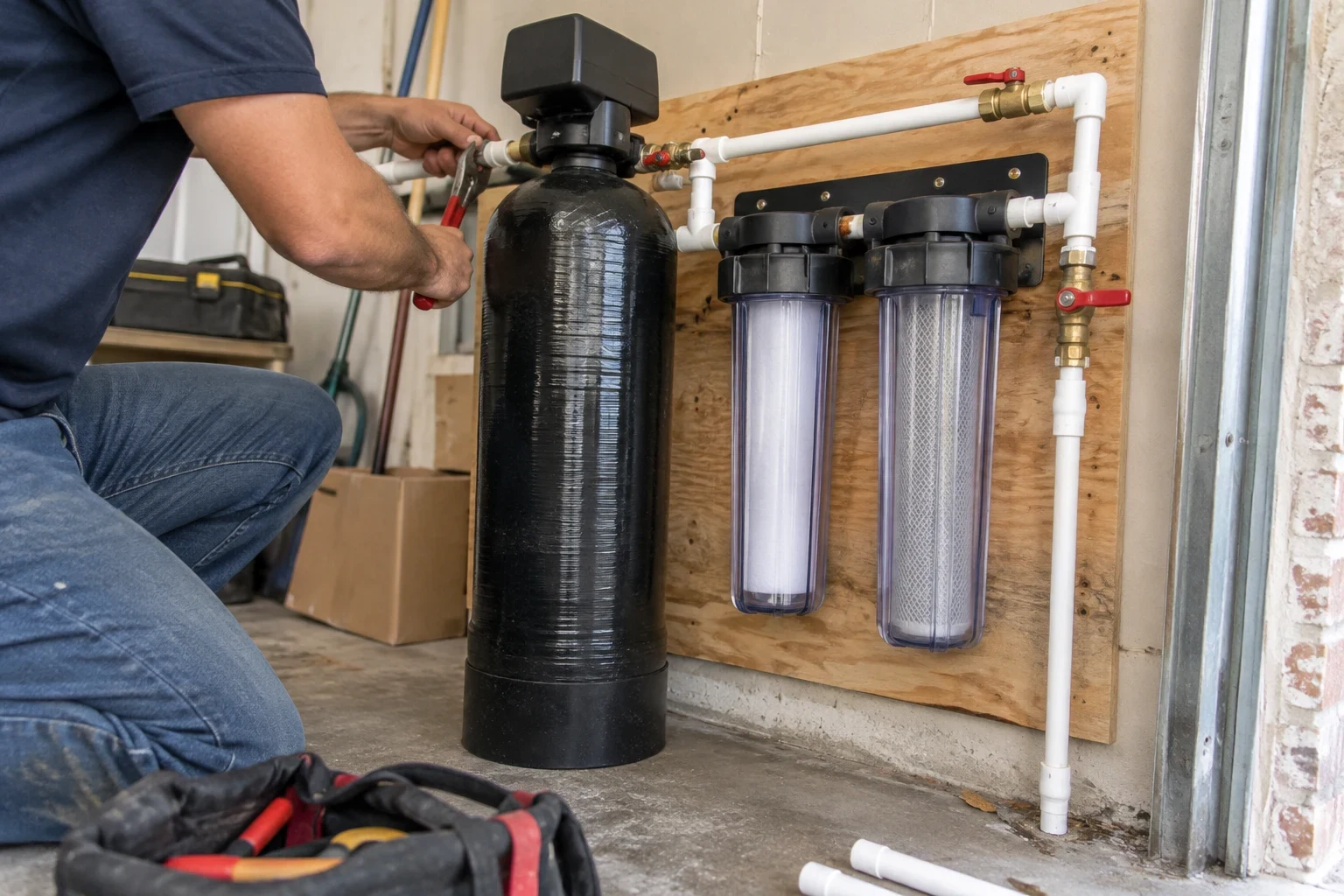
Your utility adds chlorine or chloramine to keep water free of bacteria between the treatment plant and your meter. That disinfectant does its job, but some of it is still in the water when it reaches you, and that leftover is the pool smell in a steamy shower and the flat taste in a glass from the tap. A whole-home system, also called a point-of-entry system, places a tank of activated carbon on the main line just past your shutoff valve. As water moves slowly through the carbon bed, chlorine compounds cling to the carbon's surface and stay behind, long before the water reaches a faucet.
It is the right call when the complaint is house-wide: chlorine smell in the shower, dry skin or hair after bathing, or an odor at every faucet. If your only concern is what you drink and cook with, a reverse osmosis unit under the kitchen sink is usually the better fit, and we will tell you so. When the cause of a taste or smell is unclear, water testing comes first, and the results decide which equipment, if any, belongs in your home.
What comes with a whole-home filtration install
- Sediment prefilter
- A cartridge housing ahead of the main tank catches sand, rust flakes and pipe debris. Keeping that grit out of the carbon bed stops it from clogging, so the media lasts longer and your water pressure holds steady.
- The right carbon for your city's treatment
- Ordinary granular activated carbon does a good job on free chlorine. Chloramine bonds more tightly and resists plain carbon, so for chloraminated supplies we use catalytic carbon, whose treated surface breaks chloramine down much faster. We confirm which disinfectant your utility adds before we specify the media.
- Tank sized for your flow
- The tank has to hold enough carbon that water stays in contact long enough at your peak flow, such as two showers and the dishwasher running together. An undersized tank lets chlorine slip through when demand is high.
- Bypass valve and shutoffs
- Every system gets a bypass valve so you can route water around the filter for service without shutting off the whole house.
- Free installation and long-term backing
- Free installation is part of the purchase, and the equipment carries a lifetime warranty. You also get full services after the sale, so filter changes and questions come back to us.
Signs your home could use whole-home filtration
Chlorine smell in the shower
Heat drives chlorine out of the water as steam rises, and a small bathroom with the door shut traps it. A filter at the kitchen sink does nothing for that.
Dry skin and brittle hair
Many people notice their skin feels tight after bathing in chlorinated water. Removing the chlorine at the main line changes every shower and bath at once.
Odor or taste at every tap
If bathroom sinks and the outdoor spigot smell like a pool, not just the kitchen, the issue is the supply, and a point-of-entry system addresses it where water enters.
Sediment in aerators and screens
Grit collecting in faucet aerators or the washing machine inlet screen points to particles in the line. A sediment prefilter stops them before they reach fixtures and valves.
Older plumbing you have questions about
Carbon is not a lead treatment on its own, so if your home has older pipes we recommend a test first. The results tell us whether whole-home carbon, an under-sink system or both is the honest answer.
What moves the cost of a whole-home system
Installation is free, so the price comes down mainly to the equipment your home needs. A two-person house with one and a half baths needs a much smaller tank than a family with four bathrooms. We give you the reasons behind every line on the quote by phone.
Tank size and flow rate
Larger homes with more fixtures running at once need more carbon and a bigger tank to keep contact time up and pressure loss down.
Type of carbon
Catalytic carbon for chloramine costs more than standard granular carbon. We only specify it when your water calls for it.
Prefiltration and add-ons
Homes with more sediment may need a larger prefilter housing. Some homes also pair the system with a softener or an under-sink reverse osmosis unit, which adds equipment.
Plumbing at the install point
Line size, pipe material and how much room there is near the main affect the fittings and bypass parts we use.
How the work goes, start to finish
- 1
A phone conversation
You tell us what you are noticing and where, and we ask about your home: number of bathrooms, people in the house, and where the main line enters. That is often enough to know whether whole-home filtration is the right tool.
- 2
Look at the water and the plumbing
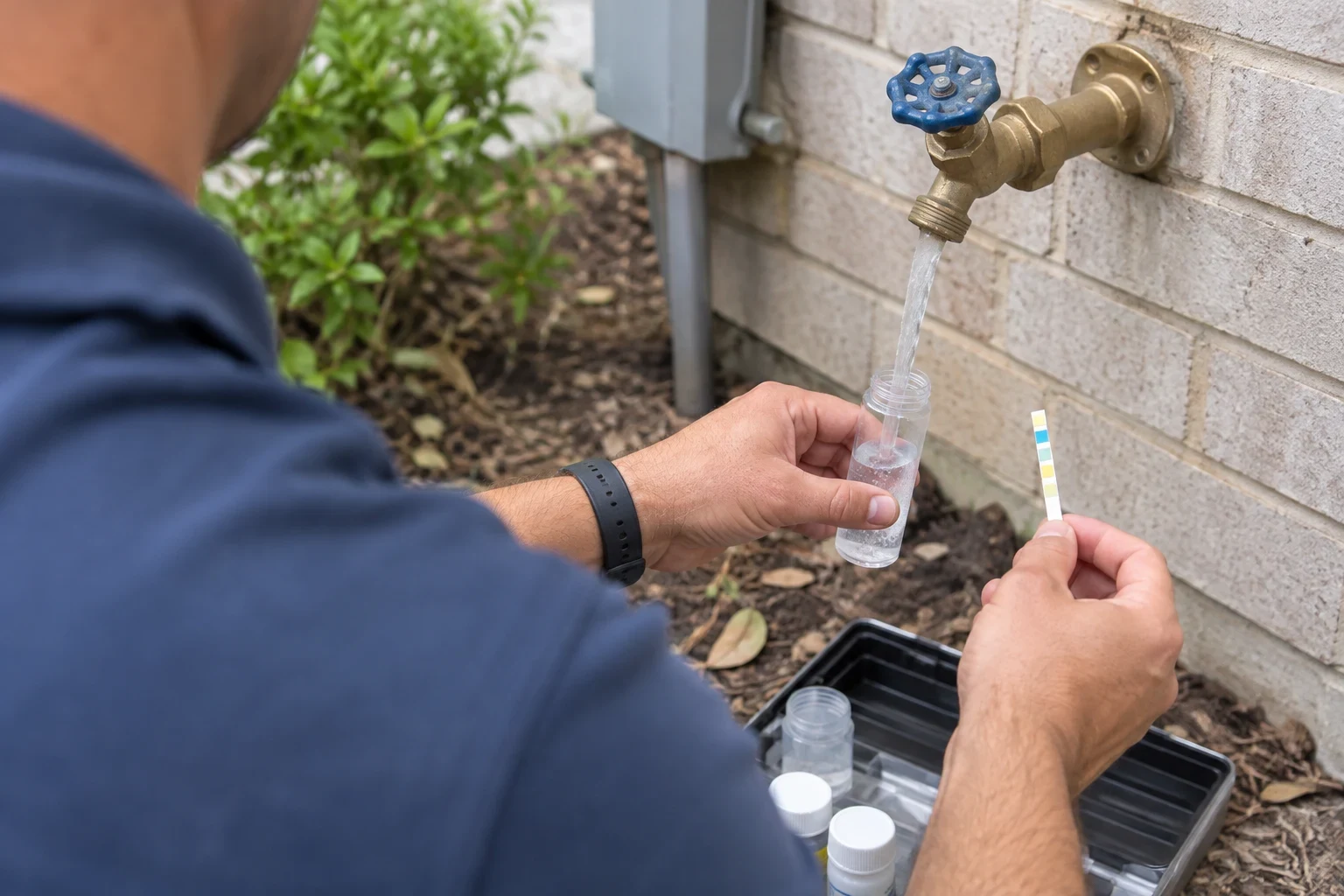
We confirm your disinfectant and, if needed, run water testing. We also check the main line size and find the best place to cut in, typically in the garage or near where the line rises outside.
- 3
Recommendation in plain terms
You get the system we suggest, the media inside it, why that tank size, and what it will and will not remove. If something else would serve you better, we say so.
- 4
Installation day
We close the main, tie the system into the line past your shutoff valve, build the bypass loop and anchor the tank. Fresh carbon releases fine dust, so we run water through it until it comes out clean, then pressurize the line and inspect each fitting for drips before we tidy up. A typical job fills a morning or an afternoon, and the house goes without water only for the stretch when the pipe is cut open.
- 5
After the sale
We walk you through the bypass valve and the prefilter change schedule. Full services after the sale means you have one number for cartridges, media replacement and any questions.
Whole-home filtration questions
Will my water pressure drop after the system goes in?
Not noticeably, if the tank is the right size. When pressure does fall, the usual causes are a tank that is undersized for the number of people and fixtures it serves, or a sediment cartridge left in well past its change date. We size the tank around your busiest hour of water use and show you how to swap the prefilter so flow stays strong.
How often does the carbon need replacing?
The sediment cartridge gets changed on a regular schedule, sooner if your water carries more grit. The carbon bed lasts much longer because it works by capacity, and its life depends on how much water you use and how much chlorine is in it. We set a schedule for your household instead of quoting a generic number.
Does whole-home filtration soften water?
No. Carbon removes chlorine, taste and odor, but it leaves the calcium and magnesium that cause hardness. If a test shows hard water, a water softener is a separate system that can sit alongside the filter.
Is the water safe to drink after a whole-home filter?
Yes. It is your same treated city water with the chlorine taste and odor taken out. For an added step on drinking and cooking water, such as concerns about older plumbing, many people add reverse osmosis at the kitchen sink.
Where does the system go, and how much room does it need?
It goes on the main line just after your shutoff valve, most often in the garage or beside the house where the line comes up. Plan on floor space for a tall tank plus a prefilter housing, with enough clearance to reach the bypass valve. We pick the spot with you on the phone and confirm it before install day.
Find out if whole-home filtration fits your home
Tell us what you are noticing at your taps and we will explain what is causing it and which system makes sense. We work in Seabrook and nearby towns including Kemah, El Lago and League-area neighbors along the bay.